

US vows to cut red tape slowingCook Islands and Pacific deals
Washington is tearing down bureaucratic barriers that have delayed investment and financing in the Pacific, as the United States looks to deliver swifter results from its renewed engagement with the region.
United States deputy secretary of state Christopher Landau made this comment in response to a question from Cook Islands News at the conclusion of the two-day “Pacific Agenda: Investment, Security and Shared Prosperity Summit” in Honolulu, Hawaii, this week.
Co-hosted by the United States Government and the East-West Center, the summit was a senior-level, invitation-only forum designed to advance investment and security cooperation between the U.S. and the Pacific.
It engaged Pacific leaders and ministers, including Cook Islands Prime Minister Mark Brown, directly with United States private sector representatives to mobilise private sector investment and strengthen regional resilience through long-term growth and development.
Discussions centred on infrastructure, the digital economy, artificial intelligence, telecommunications, critical minerals, energy security, tourism and agriculture/food security.
“I think you are right, and I share the frustration of some people in the Cook Islands of hearing a lot about meetings and commitments, and then we are not seeing a lot of results,” Landau said in response to a question from Cook Islands News. “We are seeing a lot of talking and not a lot of results.”
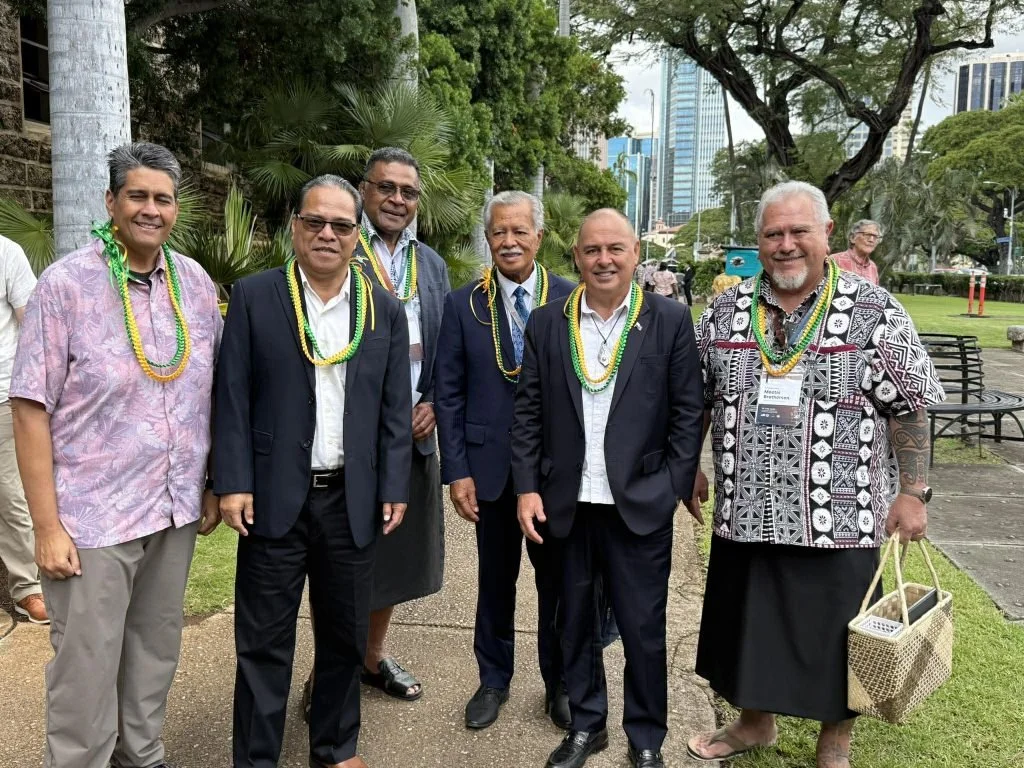
Prime Minister Mark Brown (second from right) and former Cook Islands prime minister Henry Puna, the interim director of the Pacific Islands Development Program (PIDP) at the East-West Center, in Hawaii this week with other Pacific leaders. Photo: PM MARK BROWN/ FB/26022232
Prime Minister Brown stated following the first day of the summit that the United States is keen to support the Cook Islands in tourism, infrastructure and mineral mining. He was also asked to clarify what specific deals have been reached between the two nations.
According to Landau, US President Donald Trump had been clear about the need to deliver outcomes, not just promises, and acknowledged that excessive bureaucracy within the United States government had contributed to years of delays.
“We have so many forms to fill out, and we have so many people who have to make decisions, and sometimes that takes years,” Landau said.
“We are reforming our internal process so that if you make a commitment of some sort, that doesn’t mean that you are then going into a six-year period of analysing everything that was decided.”
Landau said the United States was “vastly streamlining” its processes so that commitments made at forums such as this week’s summit could be implemented more quickly.
“We will be tearing down the kind of bureaucratic obstacles that have led to nothing but delay for so many years now,” he said.
He added that Pacific nations should also reflect on their own internal systems that can slow the implementation of agreements.
“We’ve got to get in the habit of just, when you sign an agreement, being able to actually put it into force quickly as opposed to having it fall into a black hole,” he said.
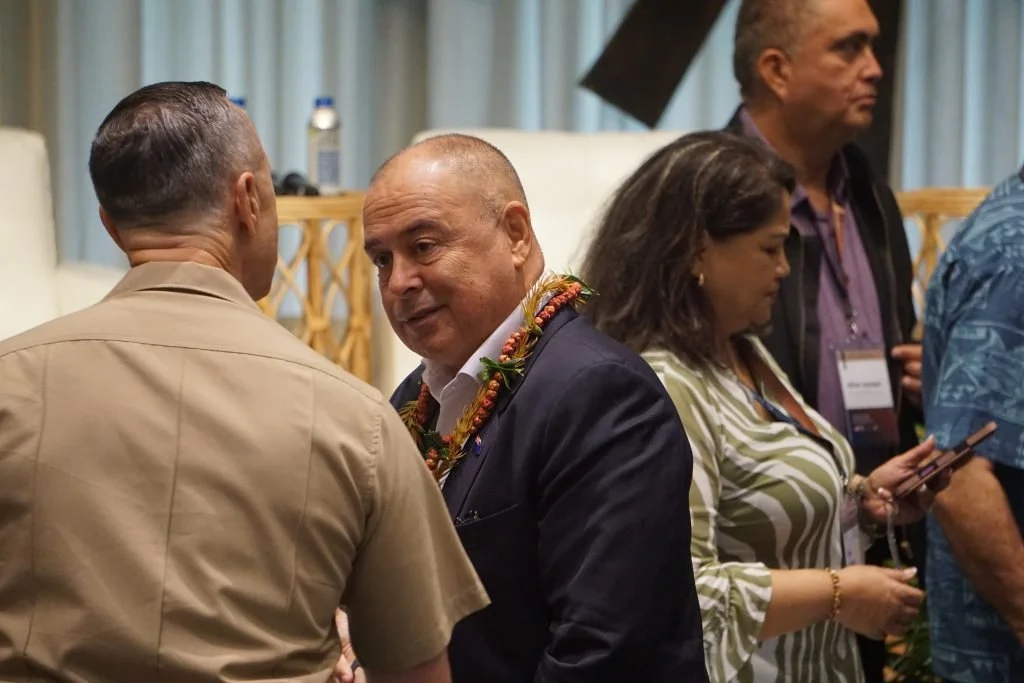
Prime Minister Mark Brown greeting the US General at the Pacific Agenda summit in Hawaii this week. 26022732
Asked about specific deals made between the US and the Cook Islands, Landau said he was not directly involved in negotiating specific deals at the summit and encouraged delegations to speak about their own outcomes.
“My job was to bring everybody together here and let them work out the deals,” he said. “All I can say is that we are committed to a very prompt way to get those things, those deals over the finish line.”
Members of the Cook Islands delegation described the summit as a positive and valuable engagement, highlighting the unique approach of bringing private sector companies directly into discussions with Pacific governments.
Chief of Staff for the Office of the Prime Minister, Karopaerangi Ngatoko, said the Cook Islands welcomed the renewed interest from the United States.
“We are absolutely wanting to take up the renewed interest from the United States in the Cook Islands, and I think it’s a really innovative approach that they’ve taken here, which is bringing private sector along to connect with governments,” she told Cook Islands News.
Ngatoko added that the summit’s focus on investment, security and shared prosperity aligned with the Cook Islands’ national development priorities, including disaster resilience, connectivity and infrastructure.
“Our interest is in that realm of, how can we support disaster resilience and strengthening, how can we look at ways to enhance our connectivity, how can we look at ways that we can advance projects that support our national development goals across the board,” she said.
According to Ngatoko, the OPM was working closely with technical agencies such as Cook Islands Investment Corporation (CIIC) and the Seabed Minerals Authority (SBMA) to engage with partners and companies brought to the summit.
CIIC chief executive Allan Jensen said a key benefit of the summit was the opportunity for Pacific nations to collaborate and share experiences.
“One big positive of this forum is the coming together of Pacific nations to collaborate, to share various perspectives and experiences,” Jensen said.
“That would be a very key benefit for us here, and with our Pacific family.”
SBMA commissioner Beverly Stacey-Ataera said the gathering had also helped reinvigorate regional relationships.
“It’s reopened and reinvigorated conversations and understanding,” Stacey-Ataera said. “Seeking to understand each other so we can support each other through the journeys that we’re taking is incredibly important.”
Ngatoko also addressed questions about access to United States development programmes, noting that the Cook Islands’ graduation to high-income status in 2020 had made it ineligible for official development assistance, including the Millennium Challenge Corporation.
The Millennium Challenge Corporation is an independent US foreign aid agency established in 2004 that reduces global poverty through economic growth.
“Our officials will continue their work to advocate for our particular vulnerabilities and why actually we think reconsideration of some of that criteria is necessary going forward,” Ngatoko said, adding that the country stood ready to engage if eligibility rules were reviewed.
On seabed mining, Ngatoko said the Cook Islands had offered to engage with other Pacific countries on its regulatory and science-led approach, which had drawn interest from across the region.
Reflecting on the closed-door sessions, she said the presence of private sector representatives signalled a shift from dialogue to action.
“I think moving from dialogue to action is really important,” she said. “Having private sector here really signals an intention to move to action and something that I think is quite unique.”
In his opening remarks at the press conference, Landau said the summit marked a departure from traditional government-only meetings, focusing instead on direct engagement between Pacific leaders and United States companies.
“The whole point of this event was to bring leaders of Pacific Island countries together with representatives of the United States private sector,” he said, adding that early signs suggested the approach had been a success.
Landau said the United States viewed its role as a facilitator, connecting Pacific nations with American companies to drive long-term prosperity and security across the region.
“I am just really excited about this new format to bring countries together,” he said, adding that he looked forward to continuing the work in the future.
The summit officially opened on Monday this week with closed sessions between the attending leaders, US representatives and private sectors from both the Pacific and the US, and closed on Tuesday.
Palau was the only country that signed a deal with the US to fund their main hospital as part of its infrastructure approach.
It is understood that other nations are awaiting the review of their deals made during the summit.
Source: Cook Islands News Written by Talaia Mika | Published in Economy, National, Pacific Islands, Regional