

Economic potential of Cook Islands polymetallic nodules ‘overstated’, suggests study
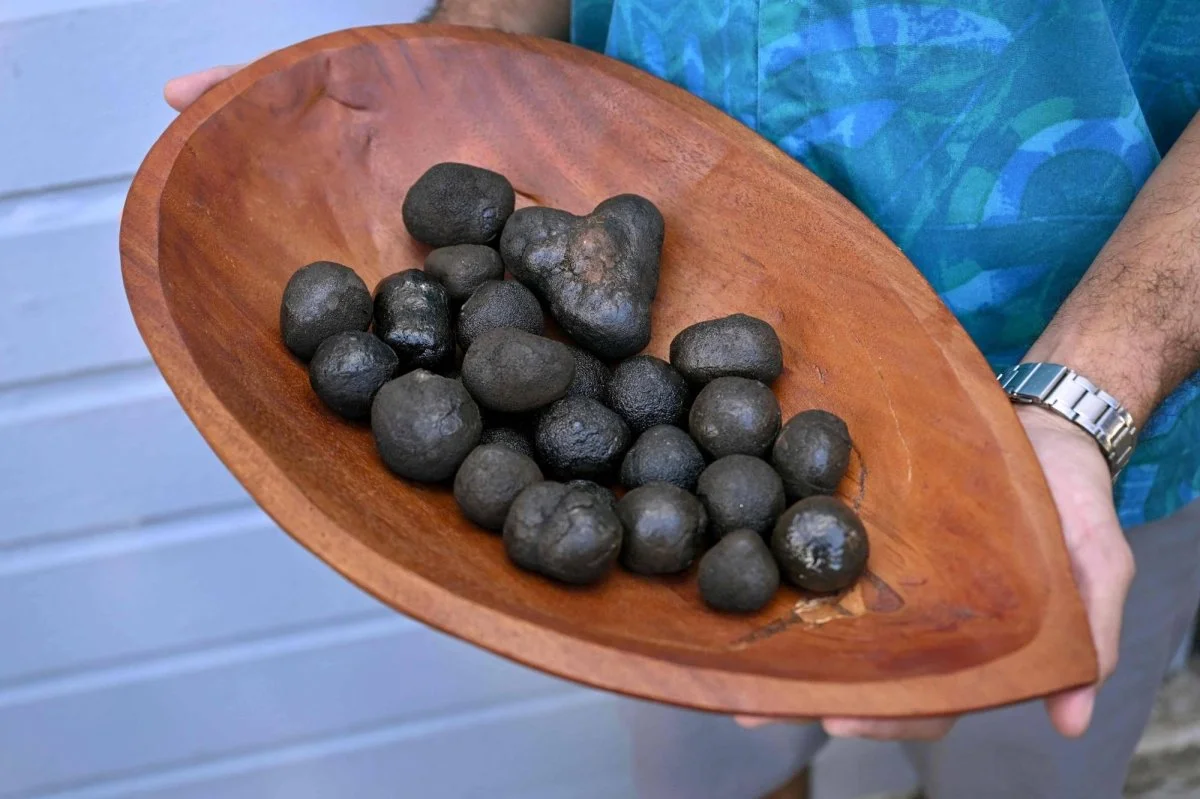
A new study suggests the economic benefits of seabed mining in the Cook Islands have been exaggerated, countering government claims that the industry will generate millions in revenue.
According to a new “independent study” commissioned by Greenpeace International – an organisation that opposes seabed mining – the economic potential of polymetallic nodules in the Cook Islands has been “overstated”.
The study by Trytten Consulting Services – a firm with 30 years of experience in the mining and metals industry – suggests that once costs, market factors and technological challenges are accounted for, deep sea mining for Cook Islands nodules is “more likely to have a negative economic return”.
Cook Islands government remains optimistic about the industry’s economic viability. The companies exploring the country’s seabed for polymetallic nodules, which contain high concentrations of valuable metals, primarily cobalt, nickel, copper and manganese, share that confidence.
According to the study, the technologies required to extract the nodules have not been commercially demonstrated, noting that operating “at depths three times greater than the Deepwater Horizon and >15 times deeper than North Sea oil, pose significant challenges to reliable operation”. The author argues that the estimated operating costs at such depths are on a par with, or higher than, their expected market value, making commercial operations unviable.
The study notes that there are no single processing facilities worldwide capable of converting raw nodules into saleable metals, and building new plants and supply chains would involve major technical and financial risks.
The study also suggests market outlook is weakest for cobalt and manganese, the primary components of value in Cook Islands nodules. The expert finds Cook Islands nodules’ estimated market value is only US$100–140 (NZ$172.16-$241.06) per dry tonne, “far below the level needed to support a profitable industry”.
“Capital and operating costs suggested by project proponents show a high likelihood of economic losses for extraction and sale of Cook Islands nodules.”
Juressa Lee, Greenpeace Aotearoa seabed mining campaigner says deep sea mining companies that have made “bold claims” to try and win social licence in places like the Cook Islands “are now being exposed – their sales pitch simply doesn’t add up”.
“Scientific warnings are crystal clear: deep sea mining will damage the oceans and harm biodiversity. Millions of people across the world, including people in the Cook Islands, are concerned about the threats posed by this industry. When you add the major financial risks, it’s hard to understand why anyone is still pushing this industry at all,” Lee said.
Cook Islands Seabed Minerals Authority (SBMA), a government agency tasked with the management and regulation of seabed minerals activity, believes commercial seabed mining has a strong chance of being economically viable based on significant investments from licence holders.
Edward Herman, SBMA director partnerships and cooperation, says the government understands from licence holders, “who are making real major investments”, that eventual commercial development has a “real chance of being economic”.
“Our current licence holders were vetted for technical competency, and they almost certainly know more than anyone else about the potential cost versus revenue of their projects, given their specific insight and work done in their exploration scope,” Herman told Cook Islands News.
“The level of studies required by the Cook Islands government are based on international standards resulting from decades of project development and learnings from thousands of projects both onshore and offshore. More importantly, specific to the Cook Islands environment and licence holder potential technical and economic models.”
Herman said that before any minerals harvesting could be licenced, the government requires “a much more detailed and complete report, than that of Greenpeace’s”. He added that the government report “will be independently checked”.
Prime Minister Mark Brown, who is also the Minister for Seabed Minerals, assured that any decision regarding seabed mining will be “critically peer-reviewed to ensure its integrity and credibility”.
Brown also said the decision to mine the nodules comes down to whether “technically, it is viable to extract nodules,” adding that whether it becomes commercially viable “is a different story altogether”.
“But again, early indications, and this is what’s pushing the interest, I guess, is not just demand for these critical metals, but the fact that when you bring up nodules, they contain not just one mineral, not one ore, but multiple. And the fact that when you do bring them up, the amount of waste and overburden is very much lower than you would find in a terrestrial mine. You don’t have to shift mountains. There is not a lot of waste that have to dispose of. But the technology will tell us whether that’s going to work or not.”
Cook Islands Cobalt (CIC) Limited, Moana Minerals Limited and Cobalt Seabed Resources Ltd were granted five-year exploration licences in 2022 to conduct scientific research and environmental impact assessments to determine if seabed mining is viable in the Cook Islands. In November, SBMA announced that companies must now apply for a five-year extension, delaying any potential mining decisions until at least 2032.
CIC Ltd country manager Shona Lynch said they are confident in the economic viability of the industry.
“We are comfortable relying on our own management team, contractors and consultants who have extensive experience in the field to determine the economic viability of any project we are engaged in,” Lynch said.
Cobalt Seabed Resources Ltd general manager Eusenio Fatialofa acknowledged the report and noted its concerns regarding extraction costs, market volatility and technology readiness, saying “these factors are not new to us”.
“They have been part of CSR’s ongoing risk assessments and strategic evaluations from the outset,” Fatialofa said.
“The report highlights challenges such as high operating costs, uncertain payability for metals, and lack of proven processing routes. CSR agrees these are critical considerations.”
Fatialofa said their current economic analysis focuses on:
“Exploration-first approach: Gathering accurate geological and environmental data before committing to large-scale investment.
“Scenario modelling: Evaluating multiple market and technology pathways, including sensitivity to future metal demand and pricing trends.
“Risk mitigation: Aligning with Cook Islands Government frameworks and international standards to ensure responsible decision-making.”
The release of the study comes as the deep sea mining frontrunner, Belgium’s Global Sea Mineral Resources (GSR) announced its plan to divest its interests in the Cook Islands and refocus on activities in the Clarion-Clipperton Zone (CCZ). GSR is selling its share of the joint venture company Cobalt Seabed Resources (CSR), which was established in partnership with the Cook Islands Investment Corporation – the entity that manages all Cook Islands government assets.
Local environment group Te Ipukarea Society (TIS), in its weekly column, recently speculated that this may be based on the “poor economic return from Cook Islands nodules compared to what was possible in the Clarion Clipperton Zone where they also have an exploration licence”.
“In that article we said nodules in the Clarion-Clipperton Zone (CCZ) are estimated to be worth approximately 50 per cent more per metric tonne than those found in the Cook Islands, based on an analysis of the percentage and value of the minerals they each contain,” TIS said.
Fatialofa said discussions with CIIC and GSR continue regarding potential investment “but no official confirmation has been made”.
He said CSR would only proceed with extraction if robust evidence supports economic viability and environmental responsibility.
“CSR is committed to transparency, rigorous evaluation and compliance with all regulatory frameworks. We aim to keep communications factual and avoid speculation.”
Source: Cook islands News Written by Rashneel Kumar | Published in Economy, Environment, National, Technology